Constfabulations by Ruchir Joshi

Kausik Mukhopadhyay doesn't work in 'Art' and he doesn't work in English.

It feels wrong and inadequate to write about Kausik's work in anything but Bangla, and that too street Bangla. And yet my Bengali isn't good enough so it is English which has to provide the jugaad.

Cancel that, turn it around: this very Bengali work could only have taken wing in a Bangla-mukta environment like Bombay; in Bengal and Calcutta this would have been subsumed, possibly buried in an eita art? eita sala ki jinish? – is this art?

The things we throw away, the things we flush down the various toilets of our lives, even as we simultaneously hoard them in various nooks and crannies of storage. Moments that keep whirring and rotating inside us long after they have passed. Stubborn-joker switches embedded in our minds, pesky things that keep flipping back on, no matter how many times we switch them off.

+++

Two plastic soldiers circle each other in a water tub and I think Spy Vs Spy from Mad Magazine; I think Joseph Cornell and Robert Rauschenberg shooting objects at each other across generations; I think Calcutta and Bombay in an unending dogfight.

I look at the riffs Kausik does on the ideas of the video screen and other screens and I want to modify the old Bengali slogan 'Amar naam, tomar naam Vietnam' , (my name and your name is Vietnam), to 'Amar naam, tomar naam, Nam June Paik!'. The intention being to say how different the work is from Nam June's while being so connected to it.

I look at the chairs Kausik has made and I'm reminded of a chair in the Stasi Museum in Berlin, the one on which they sat down the suspect so that the special seating pad could pick up their scent. The pad would be stored with the name and address and it would be given to tracker dogs to sniff if the suspect ever needed to be hunted down. Kausik's chairs are the enemy of that Stasi chair, just as many of his contraptions are urban guerillas fighting to destabilize all well-behaved objects of oppression.

But again, cancel that, for that is demanding too much duty from what is essentially a obligation-free body of work. Looking at Kausik's pieces, I'm reminded of another very different artist working on a different scale with construction materials — Richard Serra, and his insistence that the very point of art is its utter pointlessness. Or indeed a story-teller like Paul Auster who says the same thing. Add to this the Berlin mayor who declared he was 'gay, perverse and work-shy'. The thing about many of us who were forged in the megastasis called Calcutta, whether gay or not we are certainly perverse and shudderingly averse to standard notions of Work.

But work-shy doesn't add-up to being lazy. Kausik, for instance, puts in mammoth, obsessive labour into his 3-D odes to anti-work. Imagine a man sitting surrounded by what looks like mountains of junk. Instead of trash think of this resting tsunami of objects as actors in a repertory theatre with Kausik as the director. In the past Kausik would make pieces, exhibit them, bring them home, dismantle them and re-use the material to make new pieces; we can think of the flywheels, toys, loose screws and rusty turntables as actors or perhaps performance artists forming aleatory constellations in each new performance, different concertos of squeak, rattle and shake.

+++

Covid comes and changes all sorts of things. Suddenly the heart desires a different sort of clutter; a different terpsichore of tin, wire, circuitboard and wood. The new work has to be made from scratch; brand new junk for a brand-new time.

Vasai, where Kausik lives, is an industrial area with numerous small workshops and mini-factories. So, the walking into the small workshops to find the people who could execute his drawings; the initial awkward conversations with different karigars, at first mostly in Hindi and later also with detailed Auto-CAD drawings; the normal questions: 'Achha, lekin tum karna kya chaahtey ho?' and 'Yeh kiske liya hai?' What is this craziness you're making? Every craftsman needs to understand the goal for his craft. Slowly, as things form, as the ships develop shapes, as the towers stand up, the karigars begin to get it. They stop asking 'what for?' and move to the 'how to'. They become partners in the crime that is being constructed, coming up with suggestions, additions, alternatives. 'Isko aisey kartey hai, na?'

Post-Covid the craftsman who's the best at doing one particular thing for you disappears, goes back home to UP for a season, and you have to find a new guy. This happens more than once and you just have to meet more and more people to get what you need. Watching these informal engineers working within their individual skill-sets you get new ideas for what is possible.

As a result, each of Kausik's works in this show is also a map and evidence of collaborations between different kinds of skilled labour. 'I went to the industrial area and met a guy who works with lathe,' he says, 'then I met a guy who works with sheet metal and I thought I have to work with them.' And there you have it - mad Shonku or Cuthbert Calculus is certainly one image that fits, but beyond that is an obsessive tinkerer being inspired by and working with other tinkerers.

+++

In human history perhaps the last two hundred and fifty years will be seen as a period where we became obsessed with getting objects to obey our commands, a period towards the end of which we ended up being remote-controlled by the objects we had created, not only the working objects but also, centrally, all the toxic detritus with which we have filled the earth.

As has been much discussed, perhaps this is the hinge moment in our history where the very definition of the object changes forever, where begins the exchange-mutation between what we've till now understood as human and what we've understood as inanimate thing.

Kausik's precision-crafted pointlessnesses — if one can coin a word, his constfabulations — patrol the shifting LOC of these mutations.

If the works carry a language, then perhaps the earlier ones spoke more Bangla and these new pieces one of Greater Bombay's many argots. Maybe this new work is less Bengali, more Navi Mumbai, which is anything but Mumbai, more Bambai and Vasai. Or maybe it is that local jugaad has melded with Bengali jugaad, with the Bengali tradition of broken, patched up things that still somehow work, like a refrigerator or a relationship.

Among the 'inspirations' often mentioned for Kausik we get Duchamp and Dada, Ritwik Ghatak and Ram Kinkar, Jean Tinguely and Fluxus and so on. Looking up Fluxus on Wikipedia one comes across a poem American artist Carolee Schneeman wrote in reaction to the rejection women artists faced from their phallocrat counterparts in the movement:

He said we are fond of you

You are charming

But don't ask us

To look at your films

We cannot

There are certain films

We cannot look at

The personal clutter

The persistence of feeling

The hand-touch sensibility

Without over-connecting Kausik to American feminist film-makers of the 1960s, the last three lines magnet to his work – the personal clutter, the persistence of feeling, the hand-touch sensibility. Just as those pioneering women didn't fit the prevalent male definition of what constituted art, Kausik too, doesn't address the art world or its currently recognised pigeon holes.

+++

Looking at Kausik's work I immediately want to do with language what he does with objects, with levers and wiring, but it's not that easy, just as it's not easy to achieve the throwaway, verge-of-collapse giddiness of his earlier pieces or the sonorous, accidental-seeming thairaav of his new work.

In Avijit Mukul Kishore's film Squeeze Lime in your Eye, Kausik says what many Bengalis and Calcuttans in the artsphere would hesitate to say about watching Ghatak's films: 'You can't see his movies more than once. Once is enough.' Meaning the films have such an impact the first time that it's difficult to put yourself through that a second time. I myself have made the comparison that watching a Ghatak film is like drinking highly proofed country liquor in the morning. In that sense, Kausik Mukhopadhyay is one good kind of anti-Ghatak: you want to go back to his pieces again and again, to keep looking at them, even though they always leave you hanging between laughter and unease.

~ Ruchir Joshi, January 2025

And I Want To Travel Blind


 The title of the exhibition is from Leonard Cohen's song Suzanne, slightly modified. It was at Chatterjee and Lal, 9 January to 25 February. The video is by Avijit Mukul Kishore.

Old Projector Dress As A Steam Engine

The way it looked at the exhibition. Art Fair Delhi. Chatterjee And Lal. 2022


Old Projector Dressed Up As Steam Engine

 Finished this work on 13th March in two weeks. A record speed for me.


Strange Bed Fellows, On The Invitation Card


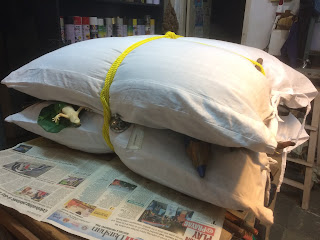
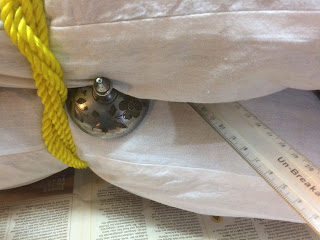
Strange Bed Fellows December 2019 Extra Large Pillow, Assembled Objects and Rope


For: DOMUS India

14 March 2017


Kausik Mukhopadhyay: Squeeze Lime in Your Eye


Ranjit Hoskote


“The second part of his apparatus was a square wire hanger. That was the receiver. If he was right, invisible waves would fly out from his transmitter, travel across the auditorium, and reach this metal hanger. To confirm that they had arrived, he had cut a tiny gap in the hanger. If an invisible wave arrived, it would have to cross that gap and would produce yet another spark.”


- David Bodanis, Electric Universe [1]


‘Squeeze Lime in Your Eye’ marks Kausik Mukhopadhyay’s triumphant return to the Indian art scene after many years spent in research, experiment and teaching at one of Bombay’s most energetic architecture schools. Like the protagonist of Ritwik Ghatak’s cinematic masterpiece, Ajantrik, Mukhopadhyay is happiest when he is talking to machines. His workspace is more laboratory or factory floor than studio, replete with motor components, IC chips, fretsaws, adzes, drills, drill bits, blowtorches, screwdrivers and cables of every conceivable size and specification (growing up as the son of an engineer, the artist embraced tools and the mechanical arts as part of his early socialisation). Improvising in the borderland between sculpture and mechanical object, he assembles and reconfigures the most fundamental machine elements – gears, levers, pulleys, motors – into complex, precarious choreographies.


Mukhopadhyay incarnates the archetype of the artist as inventor; his art-making is based on a voracious collecting practice. His primary material, as he puts it, is “discarded household gadgets”, the disjecta membra of a postcolonial economy that has made the transition from thrift to throwaway in a matter of decades. His assemblages are composed from parts found, crafted, repaired, repurposed from the tidal flows of white and brown goods on which we sail: toasters, kettles, ovens, printers, scanners, headphones, SLR cameras, computer keyboards, monitors, vacuum cleaners, and the occasional squat rotary-dial telephone that was once a standard feature of metropolitan Indian homes. Entire life cycles of manufacture, exchange and recycling are exposed to view through Mukhopadhyay’s orchestrations.


‘Composed’ may not be the right word. Riffing on the scientific working model and the booby trap as they do, these fantastic, seemingly whimsical ensembles refuse to sit still. Once the artist and his acolytes have propitiated the deities who preside over the wiring, and the synapses have fired across the contacts, rotors whirl, printer carriages shuttle and chatter across take-up reels, alarms go off hooting and screeching. Calibrations of speed, an interplay of the regular and the erratic, a counterpoint between anticipation and unpredictability are integral to the performance: for these kinetic sculptures play their role in an eccentric ballet or marionette dance of mechanical and cybernetic objects. Depending on how the circuits are organised, these works can lie still until the viewer has been lulled into trustfulness, then burst, all-systems-go, into a festive, percussive momentum verging on frenzy. Exposing the innards of the machinery at his disposal, rendering these everyday objects startlingly unfamiliar, Mukhopadhyay celebrates the latent, too-naturalised magic of the mechanical: invisible waves and fields, signals passing through the ether, forces at a distance. He is the von Karajan of a high-spirited cacophony orchestra.


*


Adopting a DIY aesthetic as he does, Mukhopadhyay turns his back on the kind of high finish that has been de rigueur in much postcolonial Indian art. However, the rough edges are deceptive; his bricolage embodies a sophisticated play with multiple historical horizons. Let us begin with his densely populated installation, ‘Small, medium, but not large’, extends across three long tables, with ancillary apparatus connected to the main frame of its machinery. There are lamps here and an optician’s equipment, as well as knobs, levers, crank handles, and a plethora of devices that have finished with their years of active service to society and entered a post-mechanical afterlife that offers us a choice of trick or treat, prank or epiphany. Except that we can’t always tell which is which.


At first glance, ‘Small, medium, but not large’ exhibits a vivid affinity with the oeuvre of the Swiss artist duo, Peter Fischli and David Weiss. Mukhopadhyay shares, with Fischli/ Weiss, a preoccupation with the encyclopaedic collection of ephemera, and with crazy perpetual motion machines; the latter preoccupation is displayed to advantage in such works as the Swiss duo’s 1987 film, ‘Der Lauf Der Dinge’ (‘The Way Things Go’). Unlike the event sequences that Fischli/ Weiss staged and documented, however, Mukhopadhyay’s works are far more non-linear, operating through blurred causalities, irregular mechanisms of delay and release, and randomized outcomes generated by the aleatory programming of a makeshift architecture.


The more time the viewer spends with ‘Small, medium, but not large’, the more s/he realizes that these tables are sophisticated and playful forms of inventory: sites where the multiplication of objects enables the proliferation of sensory experiences; staging areas where the labour of patient compiling will always be defeated by the pleasure of eccentric collecting; in effect, jokes at the expense of the archive. The senses are in the crosshairs here: Mukhopadhyay’s machinery subjects us to auditory surprises, shocks and disappointments; invites us to use a variety of optical devices to expand, distort or disorient sight; encourages us to perform actions that seem futile, but result in sudden effects, or conversely, that seem purposeful yet achieve little or nothing. ‘Small, medium, but not large’ is an elaborate ambush.


Mukhopadhyay’s emphasis on kinetic sculpture situates him in a genealogy that can be traced back to such seminal figures as Francis Picabia and Jean Tinguely. Walking through ‘Squeeze Lime in Your Eye’, doubling back in response to a half-glimpsed visual summons, alert to a shift of tone or an unprecedented sonic challenge, I am strongly reminded of Picabia’s ‘Mechanomorphs’, drawings of animated machines whose surreal, erotically charged physiognomy revealed them to be oblique, satirical portraits of humankind in the epoch of industry, capital and consumption. I am reminded forcefully, also, of Jean Tinguely’s phantasmagorical cybernetic ensembles, many of them constructed from discarded materials and orchestrated into a restless choreography, and some of which, such as the ‘Métamatics’ series, were programmed to perform and often self-destruct.


That said, I would speculate that Mukhopadhyay’s fascination with the enchantment and terror of the machine could also be continuous with that robust tradition of Bengali science and fantasy fiction, of which Premendra Mitra and Satyajit Ray were stellar practitioners. Like Mitra’s Ghana-da and Ray’s Professor Shonku, Mukhopadhyay’s artist-persona combines elements of the curious investigator, the fantasist, and the restless pioneer of uncharted horizons. [2]


“If he was right…” Sparked off by chance, a hunch, a wager, scientific explorations often proceed no differently from magic, divination and prestidigitation, as shown by the epigraph to the present essay, David Bodanis’ account of an experiment by the German physicist Heinrich Hertz to demonstrate the existence of electromagnetic waves. Born 1960, Mukhopadhyay was only seven when the far-Leftist Naxalite uprising began to sweep through West Bengal. He spent his childhood and adolescence in the politically turbulent yet culturally vibrant Calcutta of the 1960s and 1970s, reading Science Today (it was also the heyday of India’s science popularisation movement), playing with Meccano sets and mechanical clocks, crafting model boats and planes with balsa kits and miniature motors. Those of us who grew up in India in the second half of the 20th century will recognise, in the hinterland of Mukhopadhyay’s visual emphases, the imagery of the Nehruvian state’s romance with industrialisation: the cut-away section views of factories, the iconic representations of turbines, hydraulic machinery, tractors and cranes, the gleaming factory assembly-lines and heroic smokestacks, and all the other invocations to the industrial Sublime familiar from the photography of Sunil Janah and Mitter Bedi. The register of the paean is disrupted, of course, by that of the dithyramb in Mukhopadhyay’s handling.


During the mid-1980s, as a student at the Rabindra Bharati University, Calcutta – where he studied before going to Santiniketan – Mukhopadhyay became a member of the Students Federation of India, founded in 1970 as a youth wing of the Communist Party of India (Marxist). During this period, he worked with fellow artists who were involved with theatre. The reigning spirit of the stage in Calcutta, at this time, was the experimental master Badal Sircar, who had moved out of designated cultural spaces and into ‘found’ spaces in streets and neighbourhood meeting-places. Having rejected bourgeois proscenium theatre, with its elaborate sets and lighting, Sircar improvised with discontinuity, shadow psychologies, the crackling energy of events, the rough-and-tumble of circumstance. The Soviet Union, now long vanished, was an important source of cultural inspiration to many young Indians during these decades; one of Mukhopadhyay’s recent works, which features an old vinyl record produced by the USSR’s official record label Melodiya, triggers off memories of that vanished epoch.


It is in the primary armature of these early experiences, in a home that was splendidly open to the world, that I would situate the artist’s practices. I would suggest that his choices were not shaped so much as they were reinforced by his reading of Dadaism in Calcutta and Santiniketan, and his exposure to the ideas and strategies of the Fluxus group, with which he became acquainted during his residency as a fellow at the Kanoria Centre for Arts, Ahmedabad, in the early 1990s. That said, Ahmedabad was undoubtedly a fertile moment in his trajectory as a cultural producer, a time of intense dialogues with his contemporaries at CEPT (Centre for Environmental Planning and Technology) and the NID (National Institute of Design), which would influence his decision to set up base, as a teacher, at an architecture school rather than an art school.


*


Home is an insistent leitmotif in Mukhopadhyay’s recent works, as their titles attest: ‘The Cloud Home’, ‘The Music-lover’s Home’, ‘Father’s Home’, ‘Mother’s Home’, ‘Green Home’. To my polyglot consciousness, these works sing of their umbilical connection with Bengali cinema, its alternately joyous and melancholy evocation of the baadi, the elusive home and by extension homeland, shaken by the Partition of 1905, lost to the Partition of 1947, carried in memory to the refugee colonies of Calcutta, regarded with wonder from across a riverine border. Ghoti or Bangal, resident, probashi or friend of the region, no one who is associated with Bengali culture is immune to its call. In their unpredictability, precariousness and their irrepressible wondrousness, Mukhopadhyay’s kinetic sculptures encrypt the inescapeable presence of historical trauma and articulate the artistic will to bear witness and overcome.


We are reminded here, strongly, of the domestic interior and the space of the family as a fraught, crackling diagram of power relationships but also as the theatre of dreams and aspirations. Ghatak’s Meghe Dhaka Tara and Subarnarekha – the cry of the woman, diagnosed with a terminal illness, who wishes to live; the eyes of the child who hopes he will be taken to his new home, his nutan baadi – inhabit these works, as does Ray’s Jalsaghar, centred on the patron who desires to summon up lost grandeur and the richness of music one last time, before he is overtaken by bankruptcy and collapse.


‘Squeeze Lime in Your Eye’ is, I would suggest, readable as a scrambled, adroitly coded memoir, an autobiography in moving parts – of a person, a period, and an artistic stance. Kausik Mukhopadhyay imbues his broken, dismantled and recombined ensembles with soul and voice. Through this animism of the machine, he reminds us of the residues of labour, passion, hope and reverie that we may have lost to the disembodied seductions of the digital age, the forms of delegation and interpassivity disguised as interactivity that it makes all too persuasively available. This is a lesson both to the art world in particular, and to the world at large.


Notes


1. David Bodanis, Electric Universe: How Electricity Switched On the Modern World (New York: Three Rivers Press, 2005), p. 98.


2. For an account of Bengali science fiction, see Debjani Sengupta’s excellent essay, ‘Sadhanbabu’s Friends: Science Fiction in Bengal from 1882-1961’, in Jeebesh Bagchi, Monica Narula, Geert Lovink et al eds., Sarai Reader 03 | Shaping Technologies (New Delhi: CSDS/ Sarai & Amsterdam: Waag, 2003), pp. 76-82. See link (accessed 20 January 2017):

http://archive.sarai.net/files/original/e067355930e46f0f188b0fc0e5348cc5.pdf


*

Lot from Apu's camera

All photographs by Apurva Parekh
Love you Apu.


From "Squeeze Lime in Your Eye"